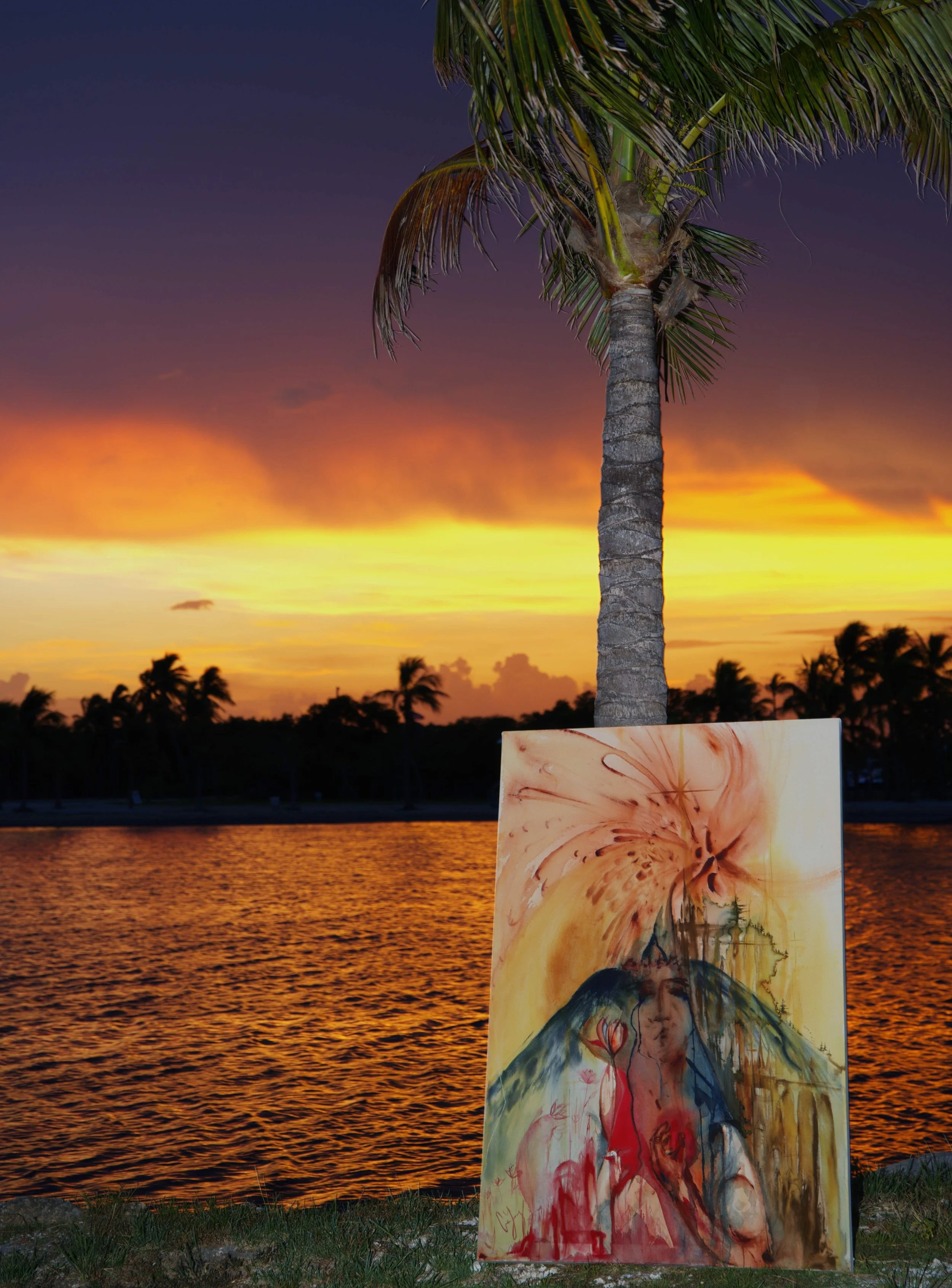
Creation is an act of throwing together; there’s beauty in collision.


Half submerged in shadow, a subject’s light becomes evident.
A horizon is where the sky meets the sea. I want to focus on the horizon. That is where the beauty of transitions become clear.
Sunsets and sunrises don’t need translation. The sun sets in the East while it rises in the West. Simultaneously.

Painting featured here: A New Eve, watercolor and ink on unprimed canvas
Speckled light
My process of beginning this body of work began in a mangrove forest.
I took my abstractly painted canvas to an edge, between the water and the trees, and watched as light danced across the canvas.
There were many birds present, watching me too.
I was interested seeing how the unfinished-ness of a painting interacts with the ever-present growth of nature. It reminded me that growth and creation aren’t a linear processes. There are fast spurts of color and curls and death. But there are also slower cycles, like the reliable movement of the sun that filters through the foliage of a forest.
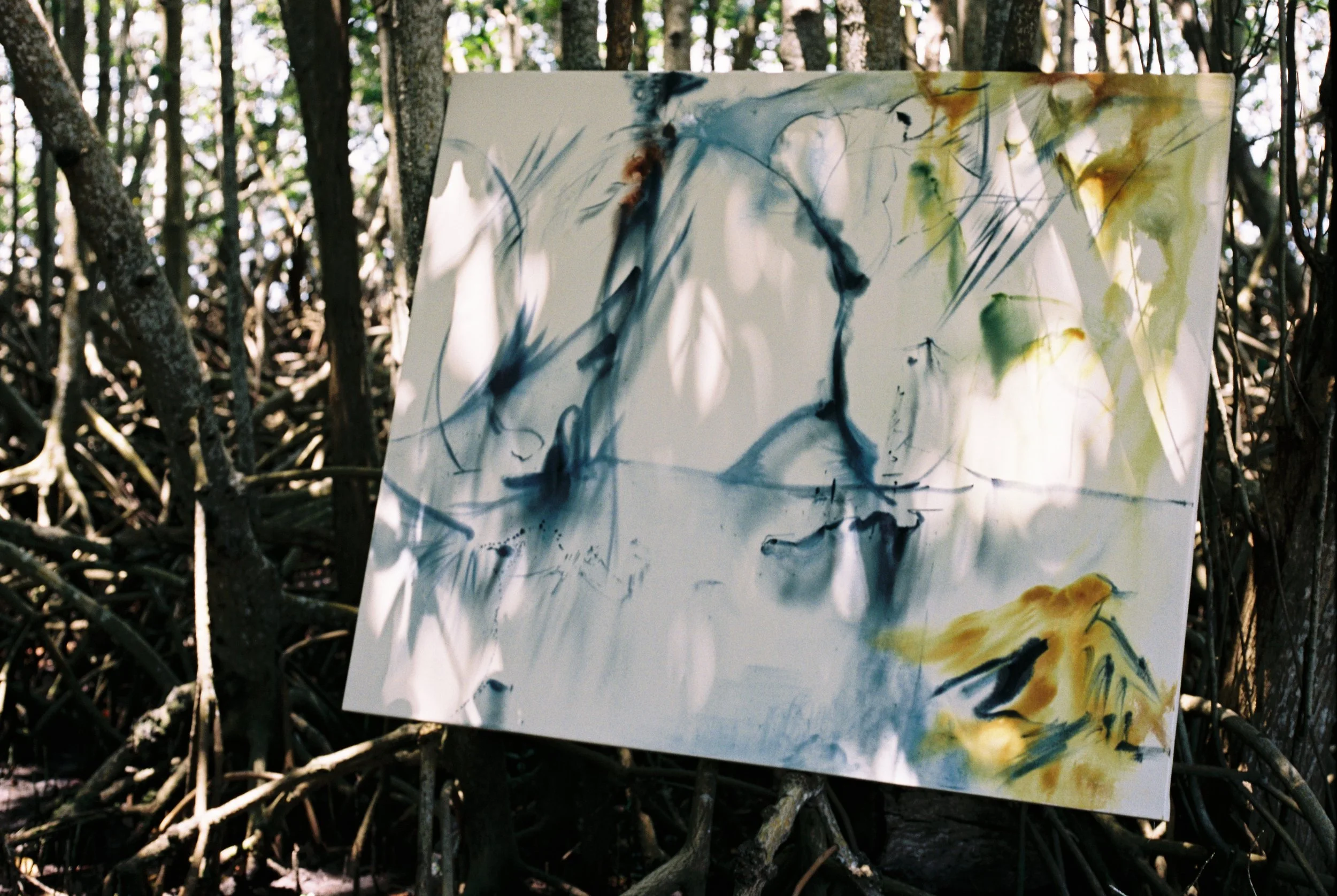
Photo of canvas in mangrove forest thanks to filmmaker Diego Alejandro Gasparutti, who collaborated with me on this project of seeing how art in nature would effect our interpretations of what constitutes as art.

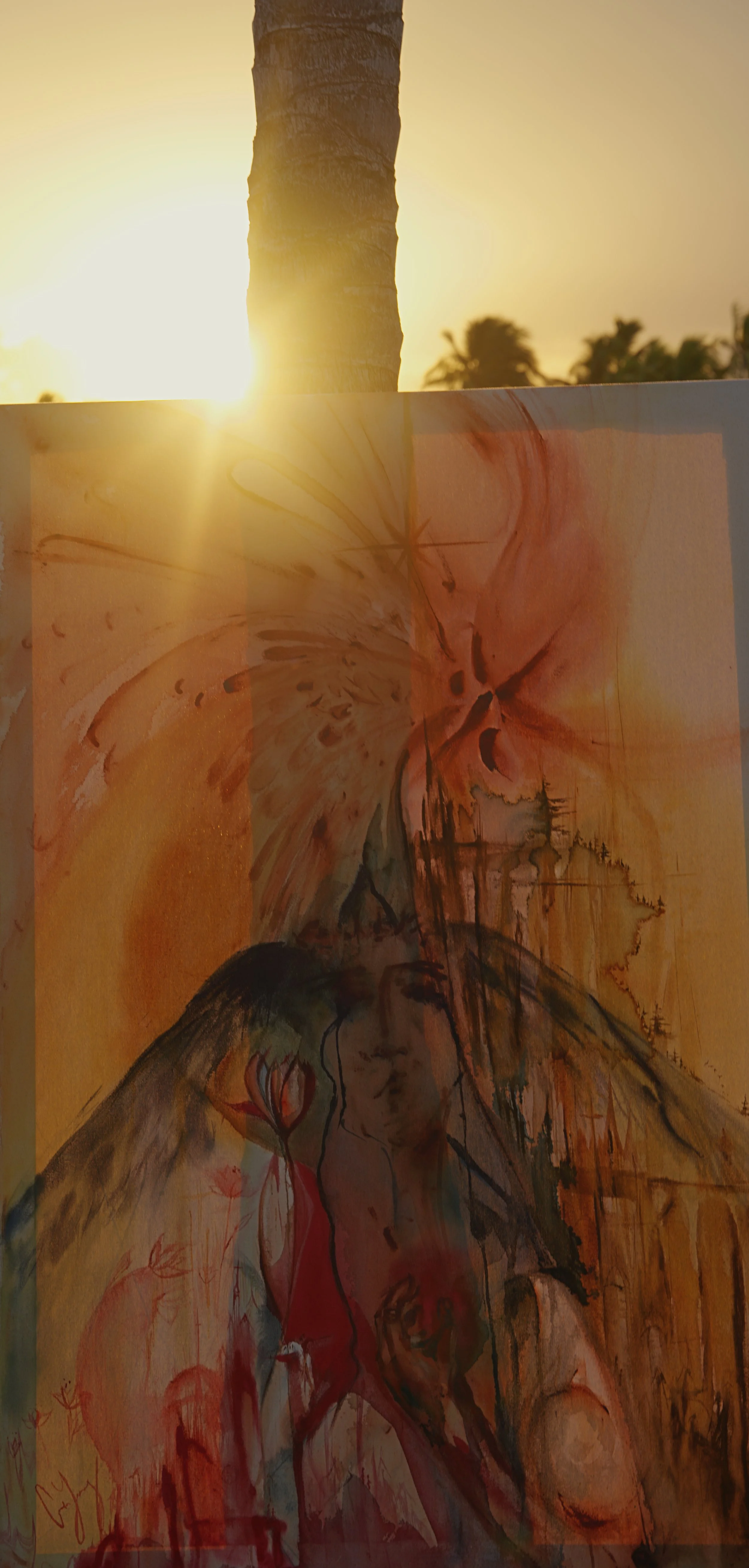
Guerilla Art Exhibition of Creation
In an attempt to make this art directly interact with the environment and people it was inspired by, I hosted a guerrilla art exhibition in the Matheson Hammock Park, a natural reserve, striking conversation with passing strangers about their relationship to art and nature.
The word guerilla is associated with a war style of diffusion. Unexpected attacks with small teams, meant to strategically overwhelm a larger army. Put “art” next to guerilla---suddenly you connect a technique of war with the power of creation.
Guerilla art (a public exhibition style) reminds me of bursts of wildflowers sprouting along the concrete. Life where life was not: a creation’s revolution against man-made impermeability.
I leaned the paintings along the trees, in a circle formation, so that if you stood in the center and spun around you’d be able to see each piece. Alongside the art, you’d see the water’s horizon-line and the land’s horizon-line. What a beautiful thing it was for my paintings to visually dwarf in comparison to the expanse that is the ocean. This was intentional. I didn’t wish for the paintings to be a focal point. I didn’t want to confuse the symbols (the paintings) for the grand experience that they intend to symbolize.
What happens when we redirect attention back to the source of inspiration? How can we challenge the notion that art, paintings, are a product? They can be so much more than a static visual—they can be an opening, a reckoning, a questioning. I do not wish to hide that the paintings seemed out of place. They were. But that strangeness was what made strangers stop to ask me why the paintings were there. And I got to ask them about their understandings of art. Most said they didn’t interact with it (art) on a daily basis. And we got to wonder what constitutes as “art” together. This is not a new debate. Many have questioned, “what is art?” I was curious about how we could pair this question with “what is experience?”
The etching of salt into the crevices of water-hit rock. The palm frond falling onto sand. The cries of a child who got too close to a crab for comfort. The sigh of an old man when he finally sits on the bench. The sun dipping orange fire into the sea. The bird diving head-first into a tumultuous tide.
I’m more interested in what experience the painting is trying to unravel.
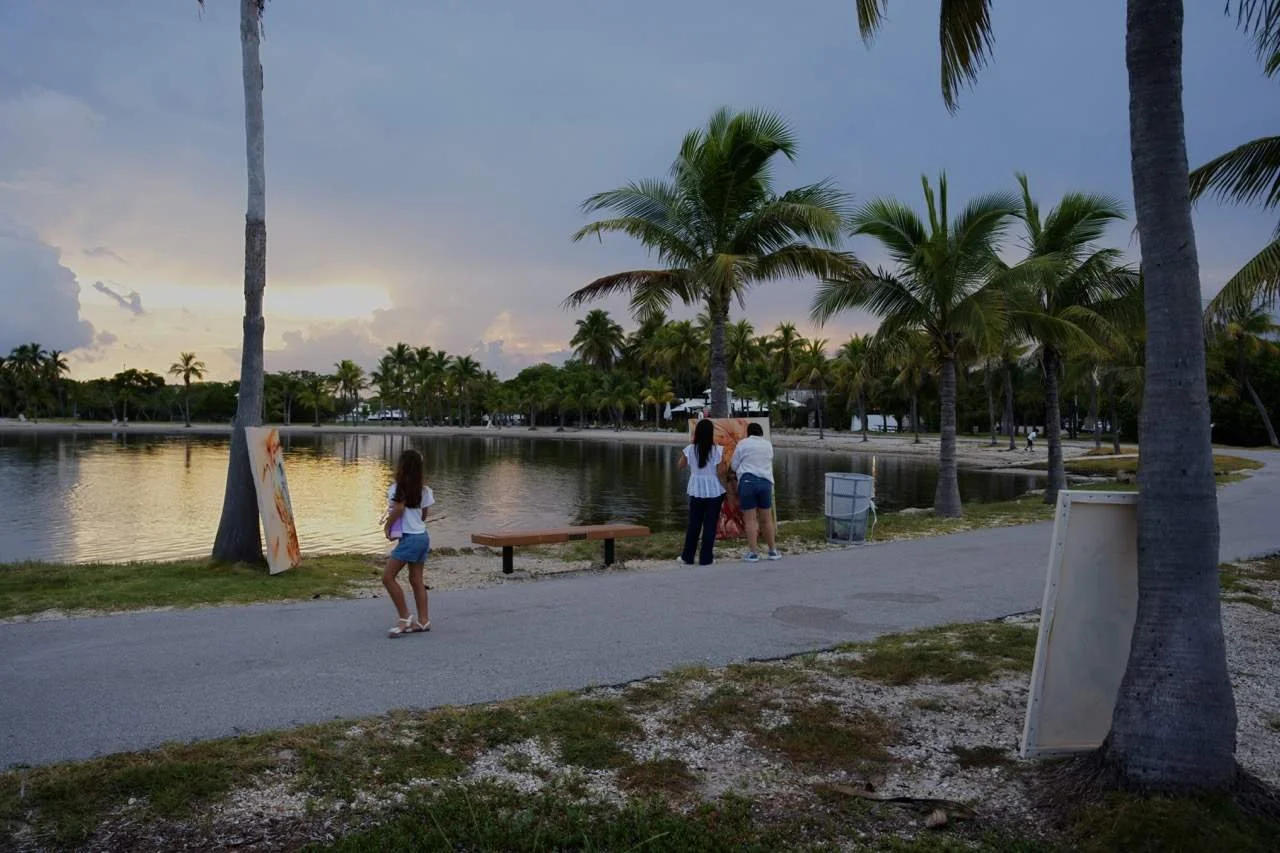
Tiny paintings alongside the grand skies.
Sheep
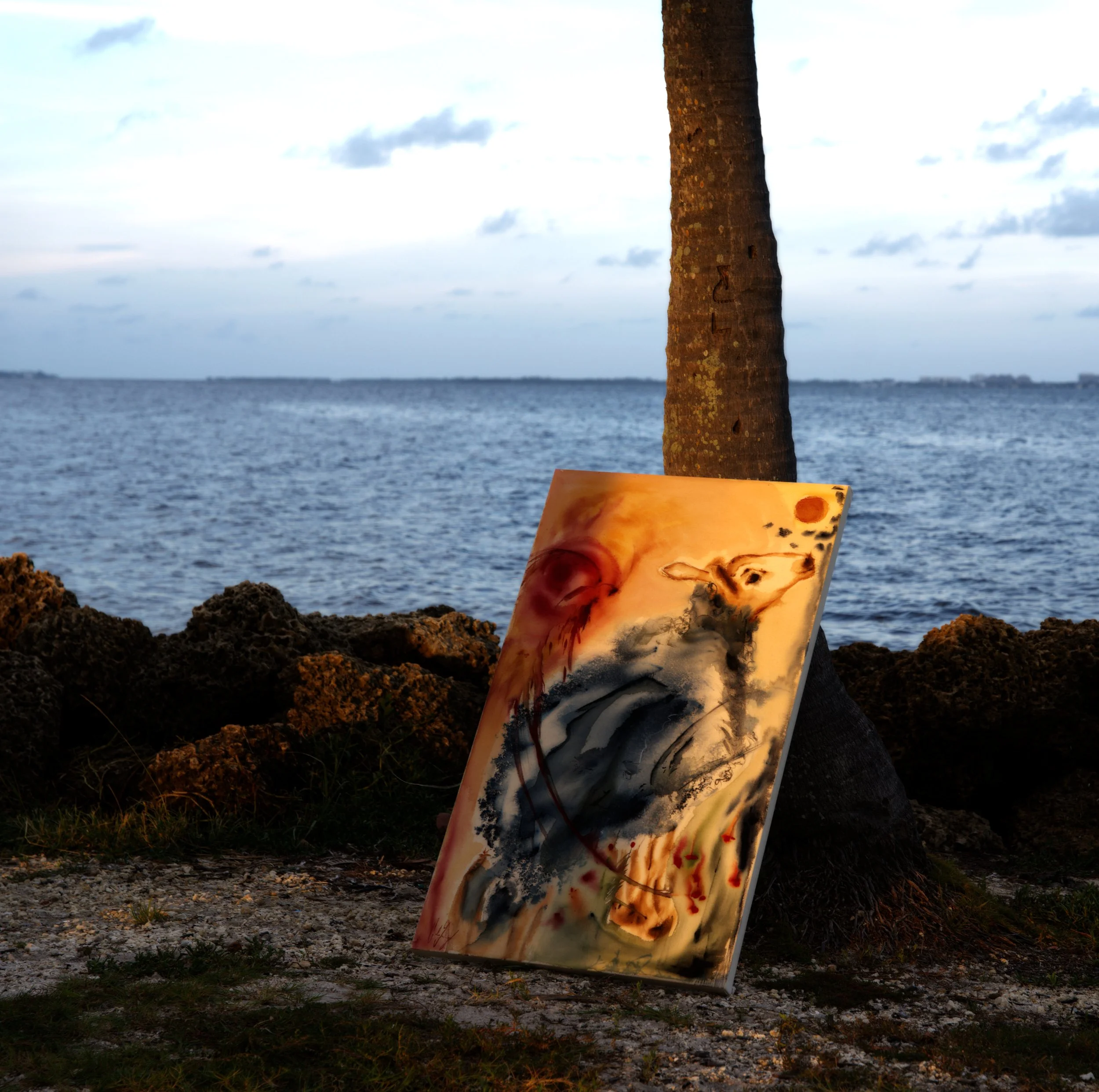
In many cultures, sheep are understood to be a symbol of purity or humility, sometimes intermingled with discussions of sacrifice. I wonder how much sacrifice is inherent to conscious and ethical creativity. What—-who—-needs to die to have honest and open conversations?
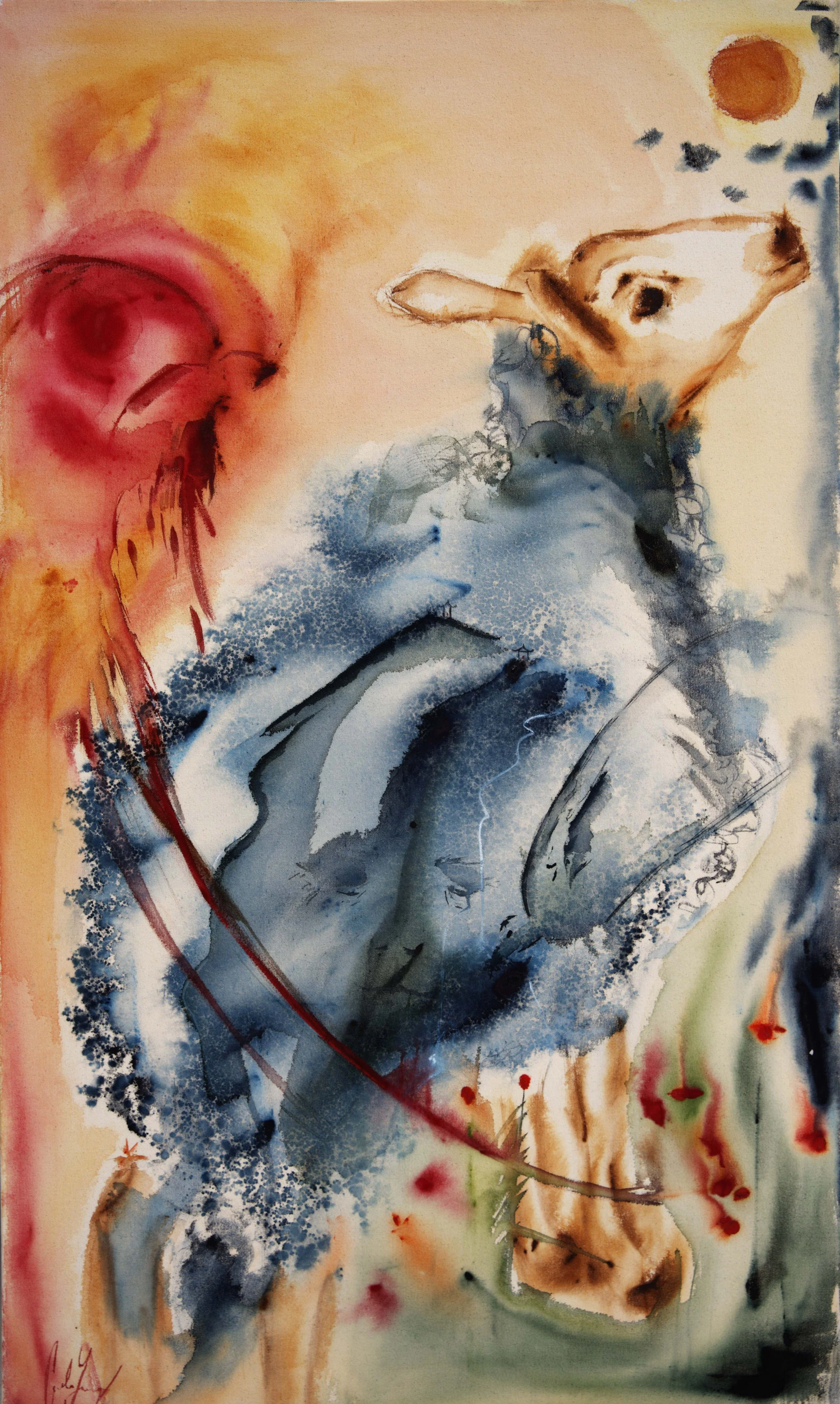
Sheep
Watercolor and ink on unprimed canvas
33’’ x 54’’
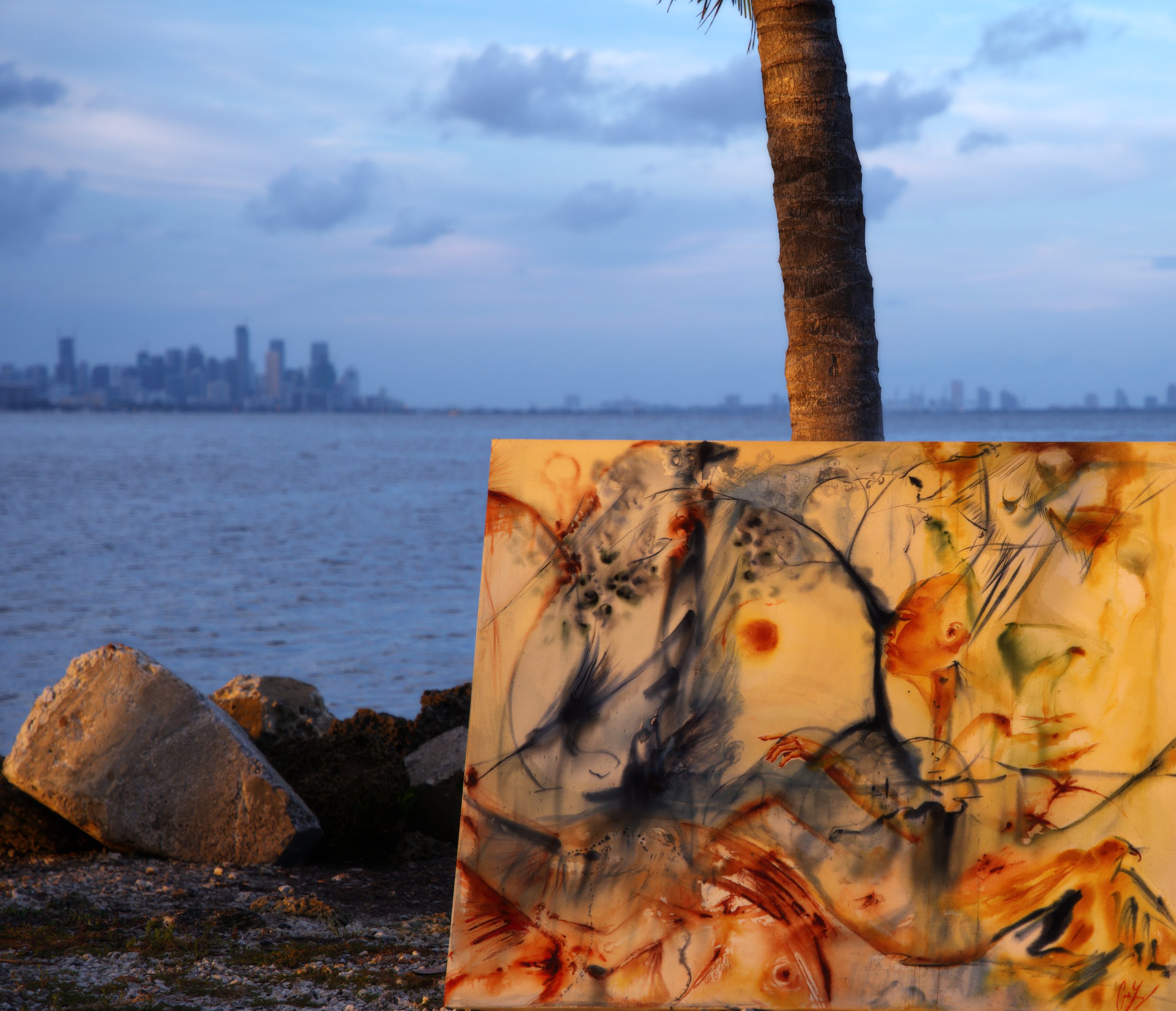
What an astounding reality that the stretch of a day has a visual marker of its finitude—a horizon!
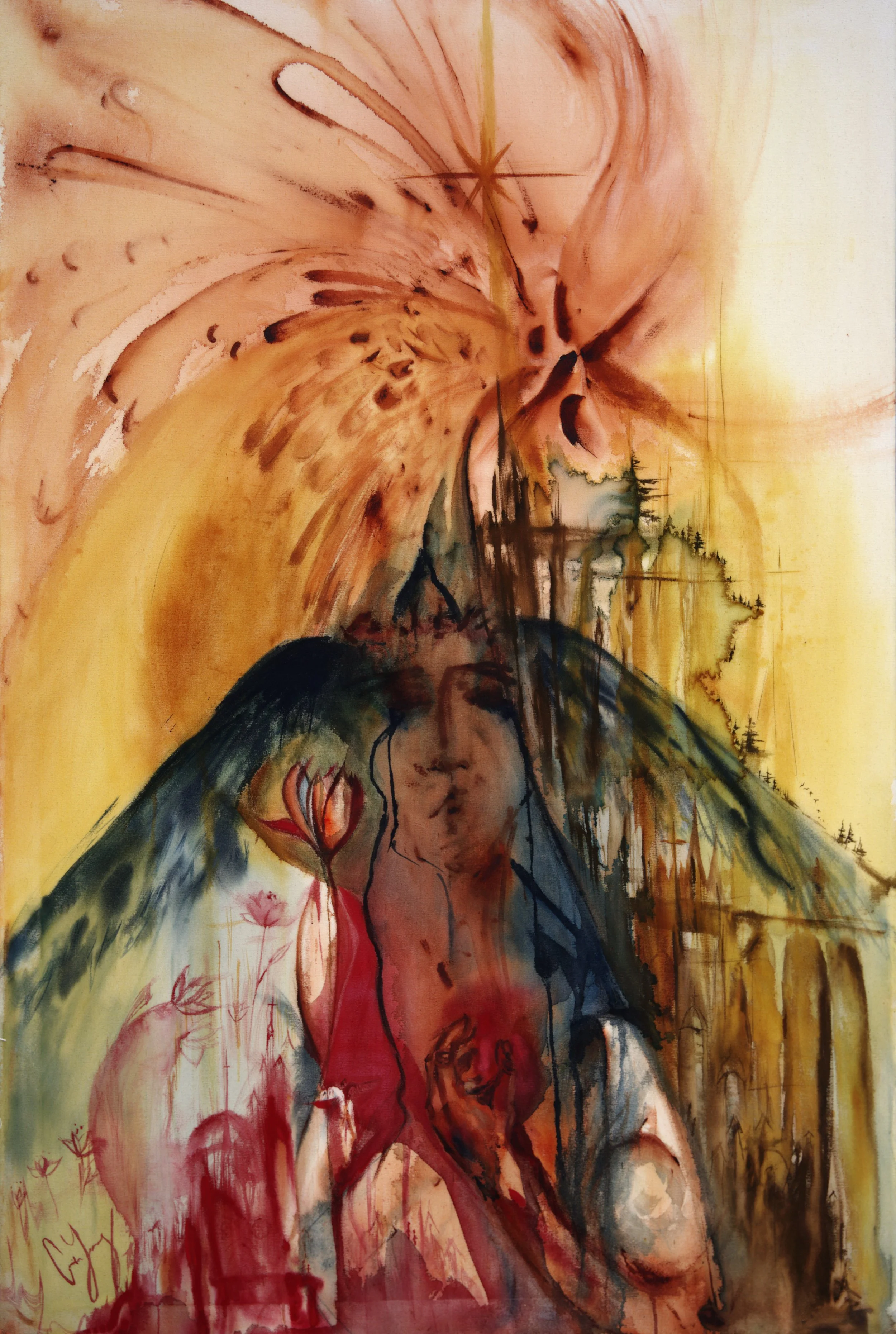
A New Adam
Watercolor and ink on unprimed canvas
40’’ x 60’’
How can we visually reinterpret the motifs of Genesis and other creation accounts? A city towering into the sky, the blood of sacrifice, the hand of Love, the cathedral, the fire, the tree, the bird.
How do these visuals resonate in modernity? How does present experience complement historical motifs?