Babel
Reimagining climate dialogues
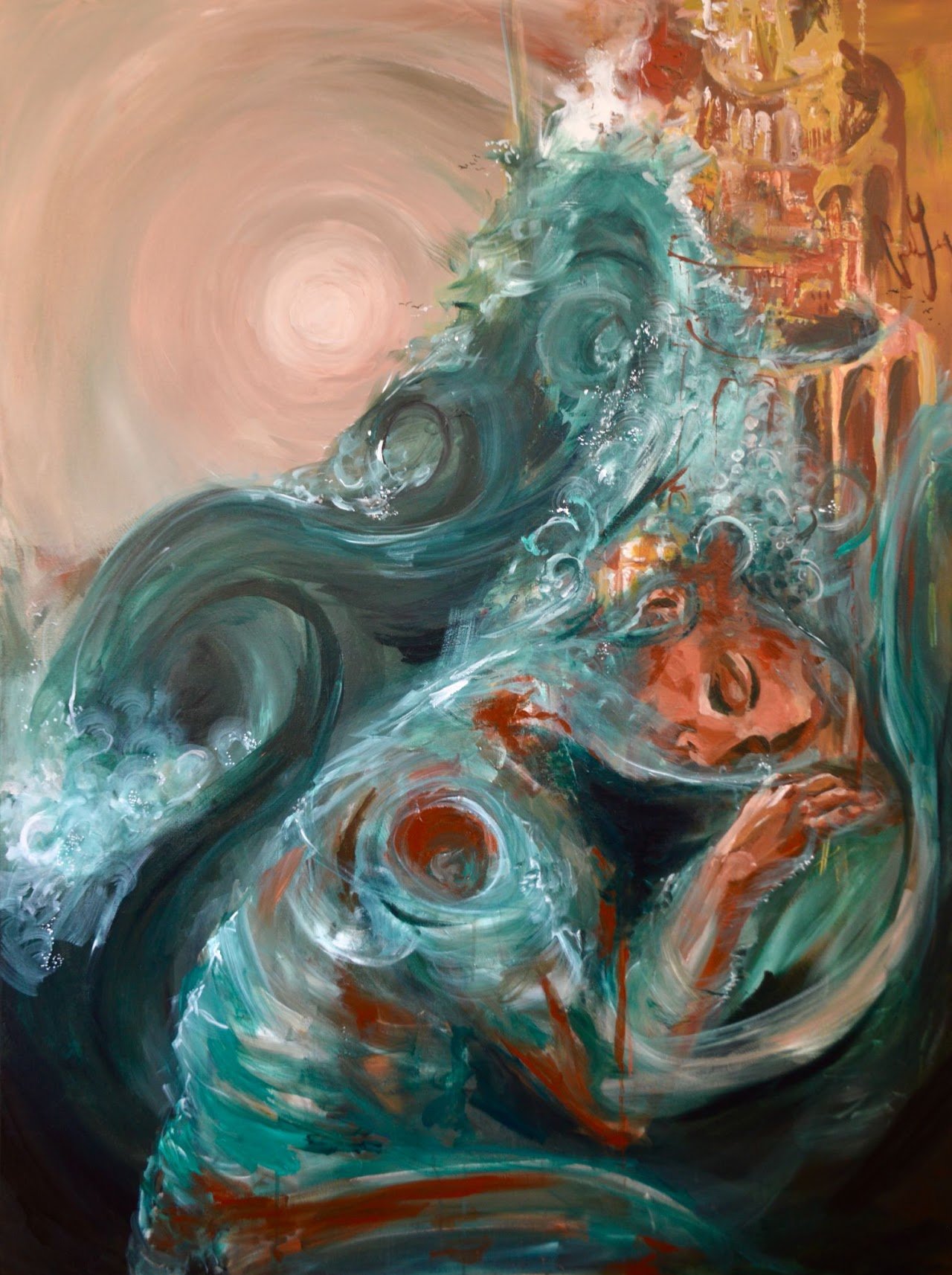
The waves in the painting are not so different from the ones that destroyed my mother’s island in 2017. Her name was Maria—the storm. I don’t blame her for the devastation on the island. The island’s resilience had already been teetering with the influence of US colonialism. The militarization of Puerto Rico by the U.S. government during and after World War II reinforced the island’s political and economic dependency on the United States. Combined with postwar policies such as Operation Bootstrap, this integration encouraged an industrial economy increasingly dependent on imported petroleum, U.S. markets, and mainland capital, leaving Puerto Rico structurally vulnerable in terms of energy security. The consolidated, fragile, energy grid is a symptom of this colonial legacy. It came as no surprise that the island would plunge into darkness at a stressor of nature. (The power grid wasn’t fully restored until 11 months after Maria.)
But this painting isn’t particularly about Puerto Rico’s energy history. This context certainly shaped my perspective, but the painting more broadly visually reminds me of how colonial history and corporate greed complicate the way we interpret natural disasters and their devastating impacts.
Does naming it a “natural disaster” dissolve culpability?
The woman in the painting bows. There are natural systems greater than her, and they envelop her.
I brought this painting to a diplomatic dialogue at the United Nations.
I was the head of Yale’s student delegation to the United Nations Framework Convention on Climate Change. With my team, a student delegation, we organized a Talanoa style dialogue, to discover what climate justice truly means in a globalized world. We partnered with the Duke delegation and various legal human rights groups, focusing our dialogue specifically on climate-induced migration. We asked questions like: what does justice mean for a refugee of a war-torn country whose natural resources and security have been exacerbated by natural stressors? Death, disease, devastation are often consequences of man-made shortcomings compounding on natural events. How does justice look like when we acknowledge the disproportionate impact of the global north in exacerbating climate change and causing devastation in less developed countries?
United Nations side events are typically conducted on a podium, with audience members physically looking upward toward the speakers. Talanoa, the method of discussion we chose, embodies the principle that all knowledge holders have equal value, disrupting conventional conference hierarchies that privilege certain voices. We sat in a circle—no podium—and encouraged a flow of conversation inspired by questions, storytelling, and honesty. We didn’t introduce ourselves as our titles, we came as people, with backgrounds.
I placed Babel on the floor, in the center of the circle. And shared my own family's story.
We contended with the cultural clashes driving a migration crisis — and imagined solutions grounded in love and kinship.
Babel is a shared story. I painted a parable. It served as a method to incite a greater reckoning and shared encounter.
I hope to do more of this.